The best adjustable difficulty dog puzzle toys turn treats and meals into engaging problem-solving sessions. Multiple challenge levels let you increase complexity as your dog learns, helping prevent boredom without making play frustrating.
This roundup compares 10 options, from beginner-friendly slow feeders and treat balls to advanced multi-step puzzles. Use the guide below to match the toy’s difficulty, design, and durability to your dog’s experience and chewing habits.
Best 10 Adjustable Difficulty Dog Puzzle Toys Picks for 2026
Best Adjustable Starter

- Three difficulty levels
- Holds 3/4 cup of food
- Doubles as a slow feeder
Best For: Beginners and intermediate dogs
Best Squeaky Training Option

- Level 2 slider challenge
- Center squeaker attracts attention
- Dishwasher-safe PP material
Best For: Small and medium dogs
Best Expert Challenge

- Level 4 expert difficulty
- Multiple movement-based tasks
- Holds 1 cup of food
Best For: Dogs that have mastered Level 3 puzzles
Best Three-Way Slow Feeder
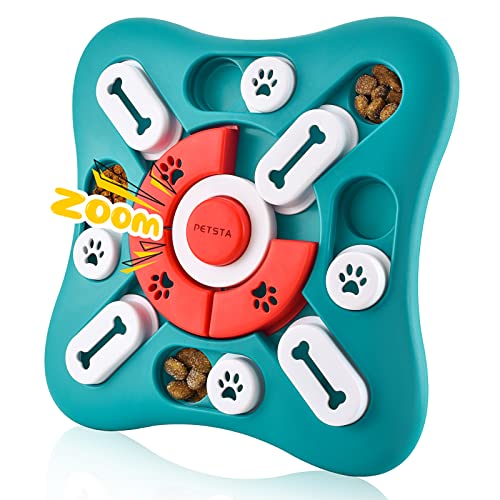
- Three play modes
- 16-hole treat dispenser
- Anti-slip and dishwasher safe
Best For: Dogs needing varied enrichment and slower meals
Best for Growing Dogs

- Three ways to increase the challenge
- Spin dispenser adds problem-solving depth
- Also works as a slow feeder
Best For: Dogs that outgrow basic puzzle boards and fast eaters
Best for Advanced Challenge

- Three adjustable levels and multiple mechanisms
- Includes 17 treat-hiding spots
- Large board suits bigger dogs
Best For: Smart dogs needing a substantial, varied indoor challenge
Best Intermediate Pick

- Level 2 spinning challenge for beginners
- Adjustable play with layers and bones
- Holds up to half a cup of food
Best For: Medium dogs ready for an engaging intermediate puzzle
Best Overall

- Five difficulty levels for gradual progression
- Six gameplay options keep treat hunts fresh
- Extra-large board fits all breed sizes
Best For: Dogs needing a puzzle that grows more challenging over time
Best Adjustable Treat Dispenser

- Adjustable openings regulate treat release
- Rolling design encourages chasing and activity
- Works with different dry-food sizes
Best For: Active dogs that prefer moving treat-dispensing toys
Best Multi-Game Board

- Three levels and four challenge styles
- Fourteen holes help prolong feeding
- Anti-slip pads support stable play
Best For: Dogs that enjoy stationary flip and sliding puzzles
Best Adjustable Starter – Nina Ottosson Dog Brick
The Outward Hound Nina Ottosson Dog Brick is a practical entry point for adjustable difficulty dog puzzle toys. Its three-part design combines bone lifting, lid flipping, and slider movement, while the included tips help you make the challenge easier or harder.
Best For: Beginners, intermediate dogs, and households that want a puzzle that can also serve as a slow feeder.
Pros:
- Offers easy, medium, and hard play options in one toy.
- Holds up to 3/4 cup of kibble or treats.
- Encourages problem-solving and interactive play.
- Lightweight and portable for indoor use.
Cons:
- Not water resistant, so it is intended for indoor use.
- Plastic construction is not designed to replace a chew toy.
Choose this model when you want a versatile puzzle that can grow with your dog’s skills without jumping straight to an expert-level challenge.
Best Squeaky Training Option – FOXMM IQ Treat Puzzle
The FOXMM IQ Treat Puzzle is one of the more approachable adjustable difficulty dog puzzle toys for small and medium pets. Dogs or cats slide the built-in slider to uncover food, while a center squeaker helps attract attention during interactive play.
Best For: Small and medium dogs or multi-pet homes seeking a Level 2 brain game with a sound-based attention cue.
Pros:
- Designed for sequential slider-based problem-solving.
- Center squeaker can help draw pets into the game.
- Food-grade PP construction is washable and dishwasher safe.
- Can support slower eating and indoor mental exercise.
Cons:
- It is not designed as a chew toy.
- Supervision is recommended, and the toy should be replaced if damaged.
- The supplied details identify it primarily for small and medium pets.
This is a sensible pick if your dog responds well to sound and food rewards, but it is less suitable for unsupervised chewing or pets needing an expert-level puzzle.
Best Expert Challenge – Nina Ottosson MultiPuzzle
The Outward Hound Nina Ottosson MultiPuzzle is built for dogs that have already mastered simpler games. As an expert-level choice among adjustable difficulty dog puzzle toys, it combines sliding tiles, a spinning wheel, and sliders to create a more complex treat hunt.
Best For: Experienced puzzle dogs of any listed breed size that need a demanding indoor enrichment activity.
Pros:
- Level 4 design provides a complex multi-step challenge.
- Offers several actions, including sliding, spinning, and moving sliders.
- Holds up to 1 cup of kibble or treats.
- Can function as a puzzle slow feeder.
Cons:
- May be too difficult for dogs new to puzzle toys.
- Its 15-by-15-inch footprint requires more storage and floor space.
- Not water resistant and intended for indoor use.
Consider the MultiPuzzle when your dog needs a substantial step up from beginner and intermediate games; for newcomers, a lower-level design should be easier to introduce.
Best Three-Way Slow Feeder – PETSTA UFO Puzzle
The PETSTA UFO Puzzle offers three play modes and three difficulty designs, making it a flexible option among adjustable difficulty dog puzzle toys. Its spin-and-slide and seek-and-hide activities use food rewards, while the 16-hole layout is designed to extend feeding time.
Best For: Dogs and cats that benefit from varied food-seeking games and a compact slow-feeding setup.
Pros:
- Combines three difficulty designs with three ways to play.
- Sixteen treat holes can extend slow-feeding time beyond 20 minutes.
- Built-in parts are designed not to detach easily.
- Anti-slip pads and dishwasher-safe cleaning add convenience.
Cons:
- The supplied dimensions list a smaller 8-by-8-inch size, which may limit capacity.
- It is not water resistant despite being easy to clean.
- Use caution with aggressive chewers.
This model stands out for variety and feeding control, particularly if you want one compact toy that can shift between different food-searching activities.
Best for Growing Dogs – Spin-and-Twist 3-Level Puzzle
This 3-level puzzle is a practical pick for dogs who need adjustable difficulty rather than a one-and-done treat game. Start with open cups, then add the spin dispenser and twist locks as your dog learns. It also works as a slow feeder for meals or treats.
Best For: Medium and large dogs, smart dogs that outgrow flat puzzles, and fast eaters needing more engaging meals.
Pros:
- Three progressive play options help increase the challenge over time.
- Spin-to-dispense play adds a step beyond basic flat boards.
- Attached sliders and twist locks prevent loose pieces from disappearing.
- Dishwasher-safe, food-grade BPA-free ABS is convenient for regular use.
Cons:
- Its wider 12.99-by-13.27-inch footprint may be cumbersome in smaller spaces.
- Recommended for dogs 10 pounds and up, so it is not ideal for very small dogs.
- Supervision is advised because it is not a chew toy.
The adjustable setup, non-slip pads, and meal-friendly design make this a strong choice when you want one puzzle to provide several stages of difficulty.
Best for Advanced Challenge – Dog Chess 3-Level Puzzle
For dogs that quickly solve simpler games, this chess-style board offers adjustable difficulty through discs, sliding doors, cups, and maze paths. With 17 hiding spots, it provides plenty of opportunities to work for treats or kibble while doubling as a slow feeder.
Best For: Smart dogs of all sizes, especially wide-pawed or long-snouted dogs that need a larger, more involved puzzle.
Pros:
- Three levels let you mix several puzzle mechanisms from beginner to advanced.
- Seventeen hiding spots encourage continued searching and problem-solving.
- Large 16.73-inch square design gives bigger dogs room to work.
- Non-slip pads and dishwasher-safe food-grade ABS support daily use.
Cons:
- The large footprint requires more storage and floor space.
- Multiple mechanisms may require more setup than a simpler puzzle.
- It is intended for indoor use.
This is one of the more feature-rich adjustable difficulty dog puzzle toys in the group, making it a good fit for dogs that need variety to stay interested.
Best Intermediate Pick – Nina Ottosson Dog Tornado
The Nina Ottosson Dog Tornado is a level 2 intermediate option for beginners or dogs ready to move beyond the easiest games. Dogs pick up bones and spin the layers to uncover treats, while the included tips help you adjust the challenge. It can also hold up to one-half cup of kibble for slower feeding.
Best For: Medium dogs and beginners who want a compact, portable puzzle with an intermediate spinning challenge.
Pros:
- Spinning layers and removable bones provide multiple ways to play.
- Tips and tricks help owners adjust the difficulty.
- Holds up to one-half cup of kibble or treats for mealtime use.
- Its 9.8-inch size is relatively compact and portable.
Cons:
- It is labeled level 2 intermediate rather than offering three built-in levels.
- The listed size and recommendation are geared toward medium dogs.
- It is not water resistant.
This is a straightforward choice for shoppers seeking an established intermediate puzzle without the larger footprint or more complex parts of the advanced boards.
Best Overall – XL 5-Level Dog Puzzle Toy
For dogs who need a challenge that can grow with their skills, this adjustable difficulty dog puzzle toy offers five levels and six gameplay options. Its extra-large board provides room for small, medium, and large dogs to work for treats or kibble through pawing, nudging, spinning, sliding, and sniffing.
Best For: Multi-stage enrichment, supervised indoor play, and households seeking one puzzle that can become more challenging over time.
Pros:
- Five difficulty levels support gradual progression.
- Six gameplay setups help keep treat hunts varied.
- Extra-large surface suits all breed sizes and supervised multi-dog turns.
- Built-in pieces and food-grade ABS construction simplify repeated use.
Cons:
- Its large 15.35-inch footprint may require considerable floor space.
- Designed for supervised puzzle play rather than chewing.
This is the most versatile choice of the group for dogs that quickly outgrow beginner puzzles. The five-stage format lets you begin with easy wins and increase the challenge as your dog learns.
Best Adjustable Treat Dispenser – Rolling Puzzle Ball
This adjustable difficulty dog puzzle toy uses a rolling, barbell-shaped design to turn treat dispensing into an active chase game. Adjustable switches at both ends let you change the opening for different dry-food sizes and control how quickly rewards are released.
Best For: Dogs that enjoy movement-based enrichment, controlled treat portions, and longer indoor feeding games.
Pros:
- Adjustable switches control food size, quantity, and play duration.
- Rolling design combines chasing with treat dispensing.
- Sturdy ABS construction has curved surfaces for quieter, scratch-conscious play.
- Compact size is suitable for small, medium, and large dogs.
Cons:
- It is not water resistant, so it is intended for indoor use.
- The product is not designed to be chewed.
Choose this model when your dog is more motivated by motion than stationary puzzles. Its adjustable food openings make it useful for tailoring reward flow and slowing access to treats.
Best Multi-Game Board – Barkwhiz 3-Level Puzzle
For a stationary option with adjustable difficulty, the Barkwhiz combines three levels with four challenge styles, including a flip game and a linear sliding track. Dogs must learn steps, follow scents, and work through treat compartments, making it a practical choice for slowing feeding while adding mental stimulation.
Best For: Dogs that enjoy hands-on slider and flip puzzles, slower treat access, and structured, supervised enrichment.
Pros:
- Three levels and four games provide multiple ways to play.
- Fourteen food holes can help extend feeding time.
- Six silicone anti-slip pads help keep the board firmly positioned.
- Built-in components are designed to stay in place during use.
Cons:
- It is not water resistant and requires cleaning with warm water and soap.
- Supervision is recommended to prevent destructive play.
- The 11.5-by-9.3-inch board may be less suitable for dogs that prefer rolling toys.
This board is a strong fit for dogs that enjoy learning a sequence of actions rather than chasing a moving dispenser. Its level system and multiple food-access routes provide variety without loose puzzle pieces.
How We Picked These Adjustable Difficulty Dog Puzzle Toys
We focused on toys that offer more than one way to control difficulty, such as movable covers, spinning parts, sliders, layered compartments, adjustable openings, or multiple game modes. We also considered treat access, likely learning curve, cleaning practicality, size, and whether the design can support independent play.
Because dogs vary widely in persistence and chewing style, “advanced” does not always mean “better.” A well-matched puzzle should be challenging enough to hold attention while still allowing your dog to succeed regularly.
Quick Comparison
| Best For | Look For |
|---|---|
| First-time puzzle users | Simple sliders, open compartments, or adjustable treat openings |
| Fast eaters | Slow-feeder channels, treat-dispensing balls, and controlled portions |
| Experienced problem solvers | Multi-step mechanisms, layered compartments, and higher challenge levels |
| Heavy chewers | Sturdy construction, limited removable parts, and supervised use |
| Multiple dogs or large breeds | Oversized surfaces, generous treat capacity, and stable bases |
Key Buying Factors
Difficulty and Adjustability
Choose a toy with a clear progression from easy to difficult. Beginners generally need visible openings and predictable actions, while advanced dogs may enjoy puzzles that require two or more steps. Adjustable openings are especially useful for controlling how quickly treats are released.
Size, Stability, and Treat Fit
Match the toy to your dog’s muzzle, paw size, and food preferences. Small kibble and soft treats work in narrow compartments, while larger treats require wider openings. A broad, weighted, or nonslip base helps prevent sliding during play.
Durability and Safety
Puzzle toys are enrichment tools, not chew toys. Inspect them before each use and supervise dogs that bite, carry, or dismantle toys. Avoid designs with damaged edges or loose pieces, and remove the toy when the treats are gone.
Cleaning and Food Hygiene
Look for smooth surfaces and parts that can be rinsed or removed. Wash away oily treat residue promptly, and allow the toy to dry fully before storage. Toys used with wet food usually require more frequent cleaning than dry-treat puzzles.
Who Should Buy Which Adjustable Difficulty Dog Puzzle Toys?
Choose a beginner-level slider or simple dispenser for puppies and dogs new to enrichment. Dogs that finish meals too quickly may benefit from a slow-feeding puzzle or adjustable treat ball. Experienced, food-motivated dogs are better candidates for multi-level chess, tornado, brick, or multi-game designs that require several actions.
For powerful chewers, prioritize sturdy construction and use the toy only under supervision. For small dogs, confirm that compartments and moving parts are easy to operate without requiring excessive force. Large or highly persistent dogs may need an XL puzzle with several activities, but rotate it with easier toys to prevent frustration. Regardless of the model, begin at the lowest setting, reward successful attempts, and increase difficulty gradually.