Indoor cats need more than a full bowl to stay engaged. The right puzzle feeder turns treats or daily kibble into an opportunity to forage, play, and eat at a healthier pace.
We compared 10 interactive feeders across maze, ball, board, lick, cube, and tunnel designs to help you choose an option that fits your cat’s activity level, feeding habits, and cleanup routine.
Best 10 Cat Puzzle Feeders for Indoor Cats Picks for 2026
Best Adjustable Challenge

- Multiple difficulty settings
- Maze design slows eating
- Detachable, non-slip construction
Best For: Cats needing adjustable enrichment and slower meals
Best Feeder Ball

- Adjustable food openings
- Rolling play encourages exercise
- Works with meals or treats
Best For: Active cats that enjoy chasing their feeder
Best Multi-Activity Board

- Five different puzzle modules
- Non-slip base supports stable play
- Top-rack dishwasher safe
Best For: Cats that need varied stationary enrichment
Best Progressive Level 3 Puzzle

- Adjustable beginner-to-Level 3 play
- Fourteen compartments plus five pegs
- No removable parts to misplace
Best For: Cats progressing toward more advanced foraging puzzles
Soft Silicone Slow Feeder
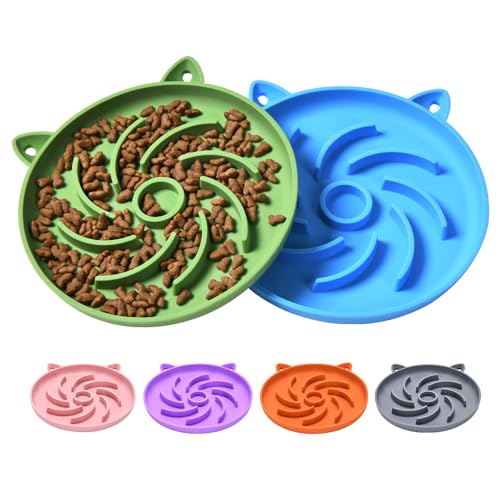
- Two food-grade silicone bowls
- Works with wet and dry food
- Dishwasher-safe and anti-slip
Best For: Cats that need a simple, gentle slow-feeding bowl
Layered Treat Puzzle
Kitty Lickin' Layers Cat Feeder

- Three spinning food layers
- Over 80 treat compartments
- Holds dry food, wet food, or treats
Best For: Bored indoor cats that enjoy interactive foraging
Play-and-Feed Enrichment

- Combines toys with slow feeding
- Rounded, non-slip ABS construction
- Includes feather teaser and track balls
Best For: Indoor cats needing active play and mealtime enrichment
Best Hide-and-Seek Feeder

- 10 treat cups encourage foraging play
- Holds up to 3/4 cup of food or treats
- Lightweight and easy to clean
Best For: Indoor cats that enjoy hide-and-seek feeding games
Best Sliding Pod Feeder

- Eight pods create a paw-and-push challenge
- Helps slow eating with gradual food release
- Non-slip and dishwasher-safe design
Best For: Indoor cats needing interactive, portion-conscious meal enrichment
Best High-Capacity Feeder

- Holds up to 2 cups of dry food
- Tunnel puzzle helps slow eating
- Non-slip pads and dishwasher-safe construction
Best For: Small cats needing a larger dry-food puzzle feeder
Best Adjustable Challenge – ALL FOR PAWS Puzzle Feeder
The ALL FOR PAWS feeder is a flexible option for shoppers comparing cat puzzle feeders for indoor cats. Its adjustable difficulty and modular design let you increase the challenge as your cat gains confidence, while the maze slows food or treat consumption.
Best For: Indoor cats that need a puzzle feeder that can grow with their skill level, including fast eaters and cats needing daily enrichment.
Pros:
- Multiple difficulty settings support beginner and advanced play.
- Combines mental stimulation with slow-feeding challenges.
- Detachable food-safe parts are designed for easier cleaning.
- Non-slip rubber feet help keep the feeder stable.
Cons:
- Its 13.1-by-8.5-inch footprint may require dedicated floor space.
- The maze may be more challenging than a simple feeder for some cats.
This is a strong pick when adjustability matters most. The stable base and cleanable construction add practical value, while the modular challenge helps keep play engaging over time.
Best Feeder Ball – PetSafe Slimcat Feeder Ball
The PetSafe Slimcat is a straightforward rolling alternative among cat puzzle feeders for indoor cats. Fill the ball with kibble or treats, adjust the openings for portion release, and let your cat chase it while working for food.
Best For: Indoor cats that enjoy movement-based play and owners who want to combine feeding, exercise, and adjustable portion dispensing.
Pros:
- Adjustable openings accommodate many kibble sizes.
- Combines feeding with chasing and exercise.
- Distributes meals into smaller portions for slower eating.
- Lightweight and portable design is easy to move.
Cons:
- A rolling ball may be less suitable for cats that prefer stationary puzzles.
- It offers a different type of challenge than multi-module puzzle boards.
The Slimcat is best when your cat is motivated by motion. Its adjustable dispensing and dual toy-feeder function make it a practical choice for active cats and mealtimes that need pacing.
Best Multi-Activity Board – TRIXIE 5-in-1 Fun Board
The TRIXIE Fun Board offers five activity modules for shoppers seeking versatile cat puzzle feeders for indoor cats. Its varied tasks turn treats or meals into a slower, more engaging routine while the rubber pads help keep the board in place.
Best For: Indoor cats that benefit from several puzzle styles in one stationary activity center, from beginners to more experienced players.
Pros:
- Five modules provide varied mental and sensory challenges.
- Supports slower eating and treat-based foraging.
- Non-slip rubber pads improve stability during play.
- Handwashing or top-rack dishwasher cleaning is supported.
Cons:
- The large 15.5-by-11.75-inch size needs ample floor space.
- A five-module design may be more involved than a basic feeder.
This board stands out for variety and stationary play. It is a useful choice when you want one feeder to offer multiple challenges and easy-care cleanup.
Best Progressive Level 3 Puzzle – Catstages Rainy Day Puzzle
The Catstages Nina Ottosson Rainy Day Puzzle is a progressive option among cat puzzle feeders for indoor cats. It offers an easier starting setup and a harder Level 3 configuration using compartments, a spinning wheel, raindrops, and treat-filled pegs.
Best For: Indoor cats that enjoy foraging puzzles and owners who want to adjust the challenge without adding a different toy.
Pros:
- Adjustable setup accommodates beginner and advanced play.
- Fourteen compartments and five pegs create varied treat-finding tasks.
- Holds up to 1/4 cup of food or treats.
- No removable parts and hand-wash cleaning simplify maintenance.
Cons:
- Hand washing is required rather than dishwasher cleaning.
- The 14-inch-plus footprint may be large for compact spaces.
- Its Level 3 challenge may require an introduction for beginners.
This puzzle is a good fit for cats ready to work through more involved foraging tasks. The adjustable modes provide a useful learning path, while the composite construction is designed for repeated indoor use.
Soft Silicone Slow Feeder – Floral Vortex Cat Bowl Set
For shoppers comparing cat puzzle feeders for indoor cats, this two-bowl set offers a simple way to slow mealtime without adding a complicated game. Its raised floral vortex design works with dry food, wet food, and fresh ingredients, while the flexible silicone construction is gentle and easy to clean.
Best For: Indoor cats that eat quickly and need a straightforward slow-feeding bowl for wet or dry meals.
Pros:
- Includes two food-grade silicone bowls in blue and green.
- Floral vortex pattern helps slow eating and may support more measured mealtimes.
- Dishwasher-safe, rinseable, and suitable for microwave or refrigerator use.
- Anti-slip base helps keep the bowl stable on a flat surface.
Cons:
- At 4.3 fluid ounces, each bowl may be small for larger meals.
- The manual bowl design provides less active mental challenge than a layered puzzle toy.
This set is a practical pick when your priority is slower eating and easy cleanup. Choose it over a more complex feeder if your cat prefers a familiar bowl format.
Layered Treat Puzzle – Kitty Lickin' Layers Cat Feeder
This layered option stands out among cat puzzle feeders for indoor cats because it combines feeding with active problem-solving. Cats spin three tiers to uncover treats or food across more than 80 compartments, creating a longer, more engaging mealtime than a standard bowl.
Best For: Bored indoor cats and food-motivated cats that enjoy foraging, spinning, and interactive challenges.
Pros:
- Three rotating layers encourage cats to search for hidden food.
- More than 80 treat compartments provide extended engagement.
- Can hold up to 1/2 cup of dry food or 1 cup of wet food.
- Works as both a puzzle toy and a slow feeder.
Cons:
- Hand-wash only, so cleanup may take more effort.
- Plastic construction may be less flexible than a silicone bowl.
- Some cats may need time to learn the rotating-layer format.
With its large capacity and multi-layer challenge, this feeder is well suited to enrichment-focused feeding. It is a stronger choice than a basic slow bowl when keeping an indoor cat occupied is part of the goal.
Play-and-Feed Enrichment – 3-in-1 Interactive Cat Puzzle
For a combination of movement and mealtime enrichment, this 3-in-1 model is one of the more active cat puzzle feeders for indoor cats. Removable slow-feeder inserts work alongside feather and track-ball toys, giving cats opportunities to play, search, and eat at a slower pace.
Best For: Indoor cats that need both physical activity and food-based stimulation, including homes with more than one cat.
Pros:
- Combines a treat feeder, feather teaser, and track balls in one unit.
- Removable slow-feeder inserts support slower eating.
- Food-grade ABS is BPA-, PVC-, and phthalate-free, with rounded edges.
- Anti-skid base and drainage holes support stable use and easier hand washing.
Cons:
- Its 10.5-inch footprint may require more floor space than a bowl-style feeder.
- The notes specify quick hand washing despite the listed dishwasher-safe feature, so care instructions may require checking.
- It offers a 30-day warranty.
This is a versatile choice for cats that lose interest in single-purpose feeders. Its larger play surface and multiple activities make it useful when you want feeding time to include exercise and mental stimulation.
Best Hide-and-Seek Feeder – Kitty Cube Puzzle
The Catstages Kitty Cube is a compact option for cat puzzle feeders for indoor cats, combining treat-hiding play with slower, more deliberate eating. Its 10 treat cups can hold up to 3/4 cup of food or small treats, giving bored cats a simple foraging challenge.
Best For: Indoor cats that enjoy hide-and-seek games and owners seeking a puzzle toy that can also serve as a slow feeder.
Pros:
- Uses 10 treat cups to encourage hunting and foraging behavior.
- Holds up to 3/4 cup of cat food or small treats.
- Lightweight, portable, and designed for everyday indoor use.
- Easy to clean.
Cons:
- Not water resistant.
- Its rectangular design may be less suitable for cats that prefer more open feeding surfaces.
The Kitty Cube is a straightforward enrichment choice for cats that like discovering hidden rewards. It is especially practical when you want one toy to provide mental stimulation and help moderate eating speed.
Best Sliding Pod Feeder – Interactive Puzzle Bowl
This sliding-pod puzzle bowl is a versatile pick among cat puzzle feeders for indoor cats. Eight pods make cats paw and push for each bite, while the food-release design helps turn meals into a slower, more engaging hunt.
Best For: Indoor cats in apartments or homes where you want a manually operated feeder for enrichment, portion control, and slower eating.
Pros:
- Eight sliding pods create varied paw-and-push challenges.
- Releases food a few pieces at a time to help slow gobbling.
- Non-slip base and smooth-gliding pods support steady play.
- Dishwasher-safe, BPA-free, PVC-free, and phthalate-free polypropylene construction.
Cons:
- At 10 by 10 inches, it requires more floor space than a compact feeder.
- Cats may need a gradual introduction, starting with treats near the outlet.
With adjustable challenge progression and eight reward points, this feeder can grow with a cat’s puzzle skills. It is a strong fit for households that want interactive meal enrichment without batteries or plugs.
Best High-Capacity Feeder – TRIXIE Tunnel Slow Feeder
The TRIXIE Tunnel Slow Feeder is a larger-format choice for cat puzzle feeders for indoor cats, using a treat-powered tunnel to make dry-food meals more interactive. It can hold up to 2 cups of dry food and is designed to discourage rapid eating.
Best For: Small cats and households that want a high-capacity dry-food feeder with non-slip stability and dishwasher-safe cleaning.
Pros:
- Holds up to 2 cups of dry food.
- Encourages slower eating for weight-control support.
- Treat-powered puzzle play adds mental stimulation and agility practice.
- Non-slip rubber pads help keep the feeder in place.
Cons:
- Its 11-by-11-inch footprint may take up substantial floor space.
- Designed for small breeds, according to the supplied recommendation.
- The tunnel format may require more exploration than simpler treat puzzles.
The Tunnel Slow Feeder stands out when capacity and stability matter. Its combination of dry-food dispensing, anti-gulping design, and rubber pads makes it a practical option for structured indoor feeding sessions.
How We Picked the Best Cat Puzzle Feeders for Indoor Cats
We evaluated each feeder by its puzzle format, difficulty, portion-control potential, stability, versatility, and cleaning demands. The selection includes options for cats that bat food, eat too quickly, prefer licking, or need more active mental stimulation. We also considered whether a feeder works with dry food, wet food, treats, or a combination.
Because cats differ widely in persistence and play style, no single design is best for every household. A simple feeder may be ideal for a beginner, while a multi-compartment board or layered puzzle can better challenge an experienced problem-solver.
Quick Comparison
| Feeder style | Best for | Food compatibility | Difficulty potential |
|---|---|---|---|
| Feeder ball | Active cats and rolling play | Mostly dry food | Adjustable |
| Puzzle board | Varied challenges and enrichment | Dry food and treats | Easy to advanced |
| Lick puzzle | Slow, calming engagement | Wet food and soft treats | Easy to moderate |
| Maze or tunnel | Foraging and slower eating | Dry food; some wet-food use | Moderate |
| Cube or multi-use toy | Cats that enjoy batting and exploring | Dry food and treats | Moderate |
Key Buying Factors for Cat Puzzle Feeders for Indoor Cats
Difficulty and Learning Curve
Start with an accessible design if your cat has never used a puzzle feeder. Adjustable openings or multiple difficulty levels make it easier to increase the challenge gradually without causing frustration.
Food Type and Portion Control
Check whether the feeder is intended for kibble, treats, wet food, or licking. A feeder that accepts part of a regular meal can provide more meaningful enrichment than one reserved only for occasional snacks. Measure portions to avoid accidental overfeeding.
Stability and Mess Control
Look for a broad base, non-slip features, or a design that stays put while your cat paws at it. Shallow compartments can reduce frustration, while enclosed mazes may limit scattered food. Place any feeder on a washable mat until you know how messy it is.
Cleaning and Durability
Removable parts and smooth, food-safe surfaces simplify routine washing. If you use wet food, clean the feeder promptly and verify the manufacturer’s care instructions. Durable plastic or silicone is generally more practical for frequent use than fragile components.
Who Should Buy Which Cat Puzzle Feeders for Indoor Cats?
Choose a feeder ball for an active cat that enjoys batting objects and working for kibble. Choose a puzzle board for households wanting several challenge types in one toy. Choose a lick-style feeder for cats that prefer wet food, licking, or slower, calmer activity.
Choose a maze or tunnel feeder for cats that eat quickly or enjoy nose-led foraging. Choose a cube or three-in-one design when you want a versatile toy that can rotate between treat dispensing, batting, and slow feeding. Whichever style you select, supervise the first sessions and introduce it gradually alongside your cat’s usual feeding routine.